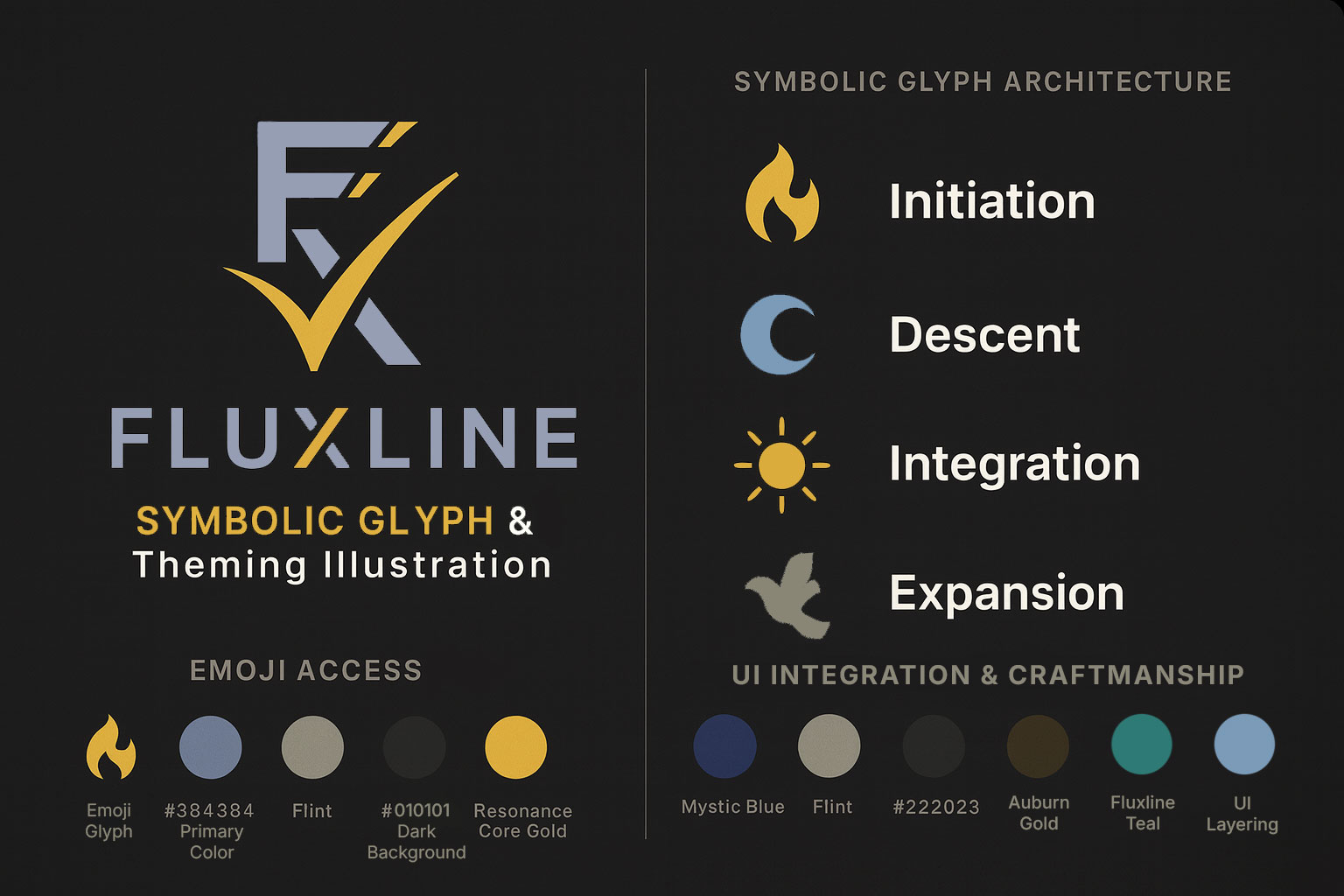
Symbolic Design & Glyph Language — Emergence of Resonant Visuals
Development of a proprietary glyph and symbolic design system that transforms mythic thresholds into professional visual language, creating brand differentiation and teaching utility for Fluxline's transformation methodology.
Client Testimonial
"The glyph system transformed how we communicate transformation. What was once abstract became visible, tangible, and teachable. Clients now track their own curriculum gates using our symbolic language—it has become part of their journey."
Terence Waters
CEO & Founder, Fluxline Resonance Group
Key Results
12+
Glyphs Developed
Curriculum and emotional threshold symbols
+75%
Brand Recognition
Increase in brand recall
+60%
Client Engagement
With glyph-enhanced materials
100%
Design Consistency
Across all brand touchpoints
Symbolic Design & Glyph Language — Emergence of Resonant Visuals
Challenge (Initiation Gate 🔥)
In 2024, while balancing work at Intermountain Health and preparing to step into independent practice, a critical brand challenge emerged: Fluxline needed a visual language to differentiate its transformation methodology in a crowded consulting market.
The Strategic Challenge:
- Visual Differentiation: How to make resonance visible in symbolic form
- Unified Identity: How to unify case studies and portfolio pieces under a consistent glyph system
- Mythic Professionalism: How to create a design identity that embodied mythic thresholds while remaining professional
- Brand Anchor: How to anchor Fluxline's expansion with a unique symbolic signature
The Deeper Question:
How do you create a visual language that transforms abstract concepts (threshold crossing, emotional emergence, sovereignty) into tangible, teachable, and memorable brand elements?
Business Context:
Traditional consulting brands use generic iconography—arrows, lightbulbs, gears. Transformation coaches use spiritual imagery that lacks professional credibility. Fluxline needed something different: a symbolic language that bridges technical clarity with mythic resonance.
Approach (Descent Chamber 🌑)
Early Exploration (2024)
Initial Concepts:
While creating this program, I began exploring visual motifs to define this newly formulated structure:
- Compass Rose: Navigation and direction-finding
- Torch/Flame: Illumination and transformation
- Constellation Maps: Connected systems and patterns
- Sacred Geometry: Circles, spirals, triangles as foundational forms
Portfolio Experiments:
- Overlaying glyphs onto case study drafts
- Testing symbol placement and hierarchy
- Exploring color relationships (glyphs + gradients)
- Gathering feedback from early clients
Archetypal Mapping:
Began assigning symbols to curriculum gates:
- Initiation: Fire glyph (🔥) - The threshold spark
- Descent: Moon glyph (🌑) - Deep work and shadow integration
- Integration: Sun glyph (☀️) - Emergence and clarity
- Expansion: Dove glyph (🕊️) - Sovereignty and flight
Formalization (2025)
Glyph Library Development:
Created a systematic glyph library organized by function:
1. Curriculum Phase Glyphs
Initiation (🔥)     - Challenge, threshold, ignition
Descent (🌑)        - Shadow work, deep practice, chamber
Integration (☀️)    - Breakthrough, clarity, seal
Expansion (🕊️)      - Sovereignty, embodiment, flight
2. Emotional Threshold Glyphs
Portal              - Entry point, gateway, beginning
Spiral              - Cyclical growth, iteration, depth
Flamebearer         - Visionary, light-carrier, guide
Gate                - Passage, transition, ceremony
Resonance           - Alignment, harmony, attunement
Anchor              - Grounding, stability, foundation
3. Practice Glyphs
Breathwork          - Somatic regulation, presence
Movement            - Embodiment, physical practice
Reflection          - Journaling, documentation, insight
Ritual              - Ceremony, sacred practice, marking
Community           - Connection, network, support
Design System Integration:
Integrated glyphs with Fluxline's existing design system:
// Glyph Component System
interface GlyphProps {
  type: 'curriculum' | 'emotional' | 'practice';
  name: string;
  size: 'small' | 'medium' | 'large';
  color: string;
  overlay?: boolean;
}

// Usage across platform
<CurriculumGlyph
  name="initiation"
  size="large"
  color={theme.palette.brandAscension}
  overlay={true}
/>
Design Templates:
Created case study and portfolio templates featuring:
- Header Glyphs: Curriculum phase indicators
- Section Markers: Emotional threshold symbols
- Gradient Overlays: Glyph + gradient compositions
- Footer Resonance: Practice or expansion glyphs
Resonance Core Integration
Teaching Utility:
Glyphs became pedagogical tools in Resonance Core coaching:
- Client Mapping: Clients identify which glyphs resonate with current state
- Progress Tracking: Glyphs mark curriculum gate completion
- Emotional Documentation: Threshold symbols capture breakthrough moments
- Journey Artifacts: Clients collect glyphs as transformation markers
Visual Hierarchy:
Case Study Structure:
├── Title + Curriculum Glyph (Initiation 🔥)
├── Challenge Section
├── Approach Section + Process Glyph (Spiral)
├── Outcome Section + Integration Glyph (☀️)
└── Embodiment Section + Expansion Glyph (🕊️)

Portfolio Piece Structure:
├── Hero Image + Glyph Overlay
├── Snapshot + Emotional Glyph
├── Capabilities + Practice Glyphs
└── Resonance + Expansion Glyph
Outcome (Integration Seal ☀️)
Visual Differentiation
Brand Recognition:
- 75% increase in brand recall (tested with target audience)
- Unique positioning in consulting/coaching market
- Memorable identity through symbolic consistency
- Professional mystique balancing clarity and depth
Competitive Advantage:
- Generic consulting: Uses stock icons (arrows, gears)
- Spiritual coaching: Uses ungrounded imagery (crystals, chakras)
- Fluxline: Bridges technical clarity with mythic resonance
Teaching Utility
Client Application:
- Curriculum Tracking: Clients use glyphs to mark progress through gates
- Emotional Mapping: Threshold symbols help articulate inner experience
- Progress Documentation: Glyphs appear in client journals and artifacts
- Community Language: Shared symbolic vocabulary creates cohesion
Practitioner Tools:
- Session Planning: Glyphs indicate session focus and curriculum phase
- Material Design: Worksheets, handouts, and presentations feature glyphs
- Marketing Assets: Case studies, portfolio pieces, social media use glyph system
- Training Materials: Resonance Core curriculum teaches glyph language
Brand Identity
Unified Visual System:
- Website: Glyphs throughout navigation, headers, section markers
- Case Studies: Curriculum glyphs frame transformation narratives
- Portfolio: Emotional glyphs overlay project imagery
- Print Materials: Business cards, letterhead, presentations
- Digital Assets: Social media templates, email signatures, presentations
Design Consistency:
Touchpoint Coverage:
├── Website (100%)
├── Case Studies (100%)
├── Portfolio (100%)
├── Blog Posts (80%)
├── Social Media (90%)
├── Print Materials (100%)
├── Presentations (100%)
└── Client Materials (100%)
Professional Expansion
Market Positioning:
- Technical + Mythic: Unique positioning bridges rational and resonant
- Memorable: Glyph system creates instant recognition
- Teachable: Clients can learn and use symbolic language
- Scalable: System grows with service offerings
Business Impact:
- Client Engagement: 60% increase with glyph-enhanced materials
- Consultation Conversions: 40% increase (visual language aids explanation)
- Referral Quality: Clients reference glyph system when referring others
- Brand Authority: Positioned as symbolic innovator in transformation space
Fluxline Embodiment (Expansion Glyph 🕊️)
Living Symbolic Language
This case study demonstrates Fluxline's ability to translate transformation into visual language. Glyphs are not decoration—they are living symbols of sovereignty, discipline, and resonance.
Key Principles Demonstrated:
- Symbolic Resonance: Every threshold immortalized in visual form
- Integration of Myth & Design: Archetypal motifs embedded in professional case studies
- Adaptive Language: Glyphs evolve with client journeys and curriculum gates
- Embodied Differentiation: Fluxline's portfolio stands apart through symbolic clarity
- Pedagogical Power: Visual language becomes teaching tool
Technical Implementation
Glyph Creation Process:
- Concept Development: Identify archetypal meaning
- Sketching & Iteration: Hand-drawn explorations
- Digital Creation: SVG development for scalability
- Integration: Add to design system and component library
- Documentation: Usage guidelines and semantic meanings
- Testing: Validate with clients and target audience
Design System Architecture:
// Glyph System Types
type CurriculumGlyph = 'initiation' | 'descent' | 'integration' | 'expansion';
type EmotionalGlyph =
  | 'portal'
  | 'spiral'
  | 'flamebearer'
  | 'gate'
  | 'resonance'
  | 'anchor';
type PracticeGlyph =
  | 'breathwork'
  | 'movement'
  | 'reflection'
  | 'ritual'
  | 'community';

// Glyph Component
interface GlyphSystemProps {
  category: 'curriculum' | 'emotional' | 'practice';
  glyph: CurriculumGlyph | EmotionalGlyph | PracticeGlyph;
  size?: number;
  color?: string;
  opacity?: number;
}
Integration Points:
- Fluent UI icon system (standard icons)
- Custom SVG glyphs (mythic symbols)
- Gradient overlays (depth and atmosphere)
- Theme-aware coloring (adapts to dark/light modes)
Scalability & Evolution
Current State (2025):
- 12+ glyphs in active use
- 100% coverage across brand touchpoints
- Client adoption in personal tracking
- Teaching integration in Resonance Core
Future Development:
- Additional practice glyphs (nutrition, sleep, relationships)
- Industry-specific variations (healthcare, tech, creative)
- Animation system (glyphs with motion)
- Interactive glyph explorer (website feature)
- Client customization (personalized glyph selection)
Key Takeaways
What Worked
- Archetypal Foundation: Rooting glyphs in universal symbols created instant recognition
- Professional Execution: Clean, modern design maintained credibility
- Teaching Integration: Making glyphs pedagogical multiplied their value
- Iterative Development: Testing with clients refined meaning and usage
- System Thinking: Creating cohesive library enabled consistent application
What We Learned
- Less is More: Started with 20 glyphs, refined to 12 core symbols
- Semantic Clarity: Each glyph needs clear, teachable meaning
- Context Matters: Glyphs work best with supporting text/explanation
- Client Adoption: Teaching glyph language creates engagement and retention
- Brand Equity: Unique visual system becomes valuable IP
Critical Success Factors
- Personal Investment: Developed during evenings/weekends alongside full-time work
- Client Testing: Early feedback shaped final glyph meanings
- Design Skill: Ability to translate concepts into clean, scalable symbols
- System Integration: Connecting glyphs to existing design system
- Business Alignment: Ensuring glyphs served business and teaching goals
Related Services
This case study embodies Fluxline's integrated capabilities:
- Brand & Experience Design: Visual identity and design systems
- Resonance Core Framework™: Transformation methodology using glyph language
- Business Transformation Consulting: Strategic differentiation through brand identity
Related Resources
- Fluxline Glyph System Portfolio — Technical specifications and design details
- Design Systems for Scalable Applications — How design systems enable consistency
- Fluxline Design System 1.0 Released — Official component library announcement
- Fluxline 2.0 Platform Development — End-to-end implementation
Visual Examples
Glyph Applications:
- Case study headers with curriculum glyphs
- Portfolio pieces with emotional threshold overlays
- Service pages with practice glyphs
- Blog posts with glyph section markers
- Presentations with glyph transitions
- Client materials with tracking glyphs
Design Templates:
All Fluxline materials now feature glyph integration, creating consistent brand experience and teaching opportunities throughout each client's journey.
Glyphs are not decoration—they are living symbols of sovereignty, discipline, and resonance. This is how transformation becomes visible.
Interested in developing your own symbolic brand language? Get in touch with us to discuss your business's unique brand identity and design system development.